Thursday, October 28, 2010

Blog # 9 Menue Driven Race

              Within the reading , Menu Identities by Nakamura, she defines the term menu driven identities as a way of creating an online identity, within a a cybersociety, from the choices that are given to the user by the user interface. She states that users are limited in their choices and cannot, " modify the terms or categories available to them , then identities that do not appear on the menu are essentially foreclosed on..."(Nakamura 2002). Later within the writing, she goes on to say that most of these identities choices are further limited to a single choice by the user, even though he or she may define themselves as multiple races(Nakamura 2002). The remainder of the reading discusses how intellectuals hopped that the Internet revolution would create equality and erase bigotry and racism within non-virtual reality. Nakamaura states that the Internet has done the opposite, by reinforcing stereotypes by people who represent themselves as avatars of differing races and gender. The solution, stated by Nakamaura, is a daunting task. She says, " Until and perhaps even after increased education, economic parity, and changing cultural priorities in the " real world" make the web accessible to a greater number of racial minorities "(Nakamura 2002) can change and equal representation occur.

              Using this information , I tried to critique the“Race: The Power of Illusion” website. Upon entering the site, I was struck that it seemed to be catered to the default "white user". The site posed questions about my general knowledge of race and if I had the ability to categorize people. The site seemed to portray many option for links into the site by clicking on the eyes, but they all seemed to take me to the same internal page within the site. As awkward as I felt, I "played" the race categories " game" and found that I was a complete failure at it, with less than 15% of my choices being right. Within  a menu-driven concept of race, the site clearly defines a race that should be viewing the content, white people, and the race or races that are demonstrating the information, non white people. The way the site was constructed defines how the users can navigate the site. This site allows for the user to view information in a way the created desires. Though I think that the site is not only a tool for educating white people , but other differing races. I believe this because in the sorting part of the site, white people were a category to be sorted. 

References
Adelman, L. (2003). Race- the power of an illusion. Retrieved from http://www.pbs.org/race/000_General/000_00-Home.htm
Nakamra, L. (2002). Cybertypes: race, ethnicity, and identity on the Internet.. New York: Routledge.

Thursday, October 21, 2010

Blog # 8 Cybertyping

In Lisa Nakamura's " Cybertyping", she begins to define the term cybertyping. There are many different aspects to this word and she goes into detail within her paper. Basically, cybertyping is the “ways that the internet propagates, discriminates and commodifies images of race and racism" (Nakamura, 2002). Cybertyping looks at the techno literacy of differing users and how they are represented within the internet by the previous and current users. It also analysis how the creators of certain virtual technologies represent differing cultures through the access and implementation of their product. Nakamura explains this idea when she goes on to say that,”cybertypes are the images of race that arise when the fears, anxieties, and distress of provided western users are scripted into a graphical environment..." (Nakamura, 2002). Later in the reading, Nakamura goes on to say that cybertyping was created by the unequal access and representation of other cultures within the internet and other digital technologies (Nakamura, 2002).

Another term used within this reading is identity tourism. This is a process of when technology users take on other gender or racial qualities that are not their own and use them in a virtual environment. The users often take the use of these qualities as a “kind of lived truth "(Nakamura, 2002). This practice provides an exotic stimulation that the user would not feel from interacting within the technology as their real gender or race. 

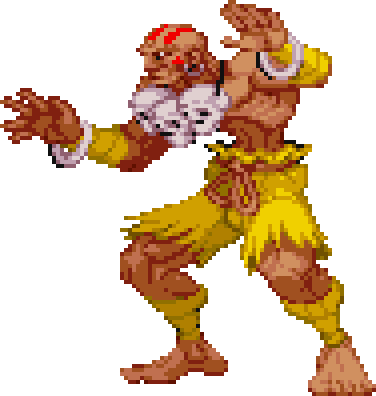
After playing street fighter, I concluded that there is a lot of cybertyping and identity tourism within the game. Clearly there are many different opportunities for identity tourism within this game. Though there are only 12 characters, the race, gender, and occupation of each gender seem to differ. Though the gender is limited to one female, whom seems to be of Asian or Caucasian dissent, this limits the amount of racial choice for the female, but a female can be played non the less. The cybertyping within this game is astounding. Each character has a “home” territory which they play at. These homes exemplify the stereotypes of each culture. Within India, the fight setting is in a palace where elephants, covered in gold, line the hallway where the fighting takes place. The character associated with this setting is a black, aborigine male. His attire is reflective of many stereotypes. He is adorned with a loincloth and a skull necklace. He is also suffering from sever starvation because his ribs are very visible. I would bet that the aboriginal people being represented by this character had no hand in his design or creation.


References:

Dhalsim Picture. Retrieved October, 21, 2010 from:
http://strategywiki.org/wiki/Street_Fighter_Alpha/Characters/Dhalsim

Nakamura, L. (2002). Cybertypes: race, ethnicity, and identity on the internet. New York: New York Routledge.

Wednesday, October 6, 2010

Blog - Mario Bros.


I am all too familiar with Super Mario Bros 2. I spent countless hours of my grade school years trying to beat this game. As a child, I never noticed the gender differences and stereotypes that were being shown to me through this game. Upon starting the game, the user is prompted to select a character that he or she would like to “play as”. The choices range from Mario, the hero, his sidekick and brother, Luigi, some deformed mushroom named Toad, and Princess Peach. Women stereotypes are emphasized as Peach is adorned in all pink attire and a crown.

Like Lara Croft, Peach is well endowed and semi disproportional. As Scheleiner states, Peach, like Lara Craft, “is seen as the monstrous offspring of science: an idealized, eternally young female automaton, a malleable, well trained techno puppet created by the male -gaze” (Scheleiner 2001).Over the decades young men have played as Peach and have manipulated her movements to the inevitable goal of finishing the level. This manipulation agrees with the idea that people can begin to test out other gender roles and identities through games. Though peach is not clad in extra short shorts and a bikini top, her feminine assets are still expressed, these include her “polygon” butt and breast, through the side scroller style of game play.

Another interesting aspect of the game is that Peach has extra power that none of the other characters have. She can hover for short distances. This gives her a great advantage in the game and would draw users to want to play her character more. It makes me wonder why the only woman in the game is given this advantage. The possible rhetoric associated with this aspect of the game is that women may need an extra advantage to succeed.

There are a few other things within this game that are troubling. Mario is the stereotypical male. He is built and strong, perfect for the main character of any action game. While playing the game, if Mario is wounded he shrinks in size. This shrinking in size could possible be communicating to the gamer that smaller people are weak. Also, Toad is clearly darker skinned color than the other 3 characters. He is also smaller in size with a large “afro” style head. I don’t know if the creators were trying to draw a correlation between black people or if I’m just reading into this.


References
Schleiner, A. (2001). Does lara croft wear fake polygons? gender and gender-role subversion in computer adventure games. Leonardo, 34(3), Retrieved from http://www.paulmuhlhauser.org/475/Readings/schleiner_laracroft

Princess peach picture. [Web]. Retrieved from http://smashgamers.com/wp-content/uploads/2008/09/super-mario-bros-2.jpg